
Dietary Fiber Powder for Busy People — A Convenient Way to Get Your Daily Fiber
Eating enough fibre every day isn't always easy. A soluble fibre powder makes it considerably simpler.
Read More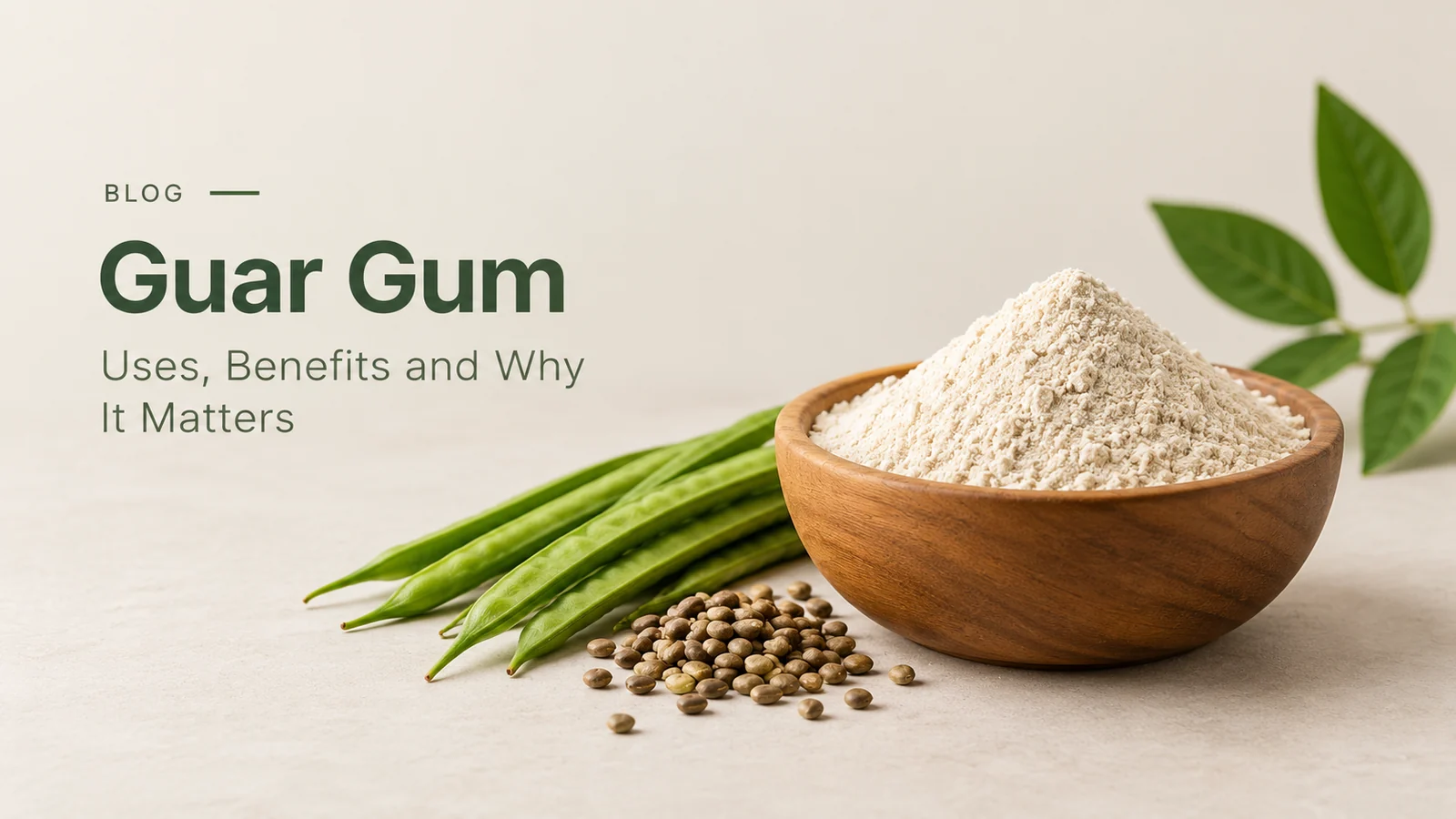
Fibre is the nutrient most people fall short on, and the one most product developers find hardest to add. Raise the dose enough to carry a label claim and most fibres announce themselves: the drink turns cloudy, the texture goes gritty, or the gut complains a few hours later. PHGG is the exception, and that is why it has quietly become one of the most useful ingredients in modern nutrition.
PHGG stands for partially hydrolysed guar gum. It is a 100% water-soluble dietary fibre made from the guar bean, Cyamopsis tetragonoloba, a hardy legume grown across the semi-arid belt of north-west India.
Guar gum in its native form is a thickener. It is the reason a sauce clings to a spoon and an ice cream holds its texture, and it works because its long galactomannan chains trap water and build viscosity quickly. That makes it excellent for texture and close to useless for fibre fortification: add enough to matter nutritionally and you have turned the product into something nobody wants to drink.
Partial hydrolysis solves exactly that problem. A controlled enzymatic process shortens those long chains into much smaller fragments. The result keeps the fibre, loses almost all the viscosity, and dissolves completely clear. Hydrolysed guar behaves so differently from the gum it came from that, in practice, they are two separate ingredients doing two separate jobs.
Production begins with guar splits, the endosperm of the bean separated from the hull and germ. These are hydrated and treated with a food-grade enzyme under tightly controlled temperature, pH and reaction time. Stop too early and the fibre is still viscous. Run too long and the chains break down past the point where they still count as dietary fibre.
The hydrolysed liquid is then purified, concentrated and spray dried into a fine, free-flowing powder. Careful manufacturing holds molecular weight inside a narrow band batch after batch, and that consistency is what keeps viscosity, solubility and fibre content predictable once the ingredient reaches a customer's production line.
Four properties do most of the work:
Taken together, these mean PHGG can usually be added to an existing product without reformulating around it. That is an unusual thing for a fibre to offer.
PHGG is best known for supporting regularity. Unlike insoluble bulking fibres, it ferments slowly and evenly along the length of the colon, which is why it is generally well tolerated at doses where faster-fermenting fibres cause bloating and wind.
It acts as a prebiotic, feeding beneficial gut bacteria and supporting the production of short-chain fatty acids. That gradual fermentation profile is the reason formulators often reach for it when the target consumer has a sensitive digestive system.
Soluble fibre slows gastric emptying and the rate at which carbohydrate is absorbed. PHGG has been studied for its effect on post-meal glucose response and on satiety, both of which are relevant to weight management and metabolic health formats.
PHGG is one of the few prebiotic fibres considered suitable for low FODMAP diets. That has made it a standard choice in products aimed at people managing IBS, a group most other prebiotic fibres have to exclude.
Benefits vary with dose and with the individual, and permitted claims differ by market. Always check the wording you intend to use against the regulations of the country you are selling into.
Specification consistency is what separates a workable PHGG supplier from a frustrating one. Before you commit to a source, ask for:
Fibre intake sits well below recommended levels in most countries, and regulators, retailers and consumers are all paying closer attention. For brands, the barrier has rarely been willingness. It has been that adding meaningful fibre used to mean accepting a worse product: thicker, cloudier, grittier, or harder on the stomach.
PHGG removes that trade-off. It lets a formulator raise fibre content without touching anything else that makes the product work, which is why it has moved from a speciality ingredient to a mainstream one in less than a decade.
Chimique Phytokem manufactures PHGG as Fibre 365 at our own plant in Haryana, from guar processed within our own group. If you are evaluating PHGG for a formulation, our technical team can send a sample, the full specification and a straight answer on pricing and lead time. Get in touch and you will hear back within one working day.

Eating enough fibre every day isn't always easy. A soluble fibre powder makes it considerably simpler.
Read More
In the search for healthier diets, soluble dietary fibre plays a role most formulations still miss.
Read More
Locust bean gum is a natural hydrocolloid used widely — modified guar gum can stand in for it.
Read MoreExploring PHGG for your formulation? Connect with our fibre specialists for technical specifications, samples, pricing, and supply details. Get expert support within one working day.