
What is PHGG? Uses, Benefits, and Why It Matters
PHGG is a 100% soluble fibre that dissolves clear and adds no thickness. Here is what it is, what it does, and how to buy it.
Read More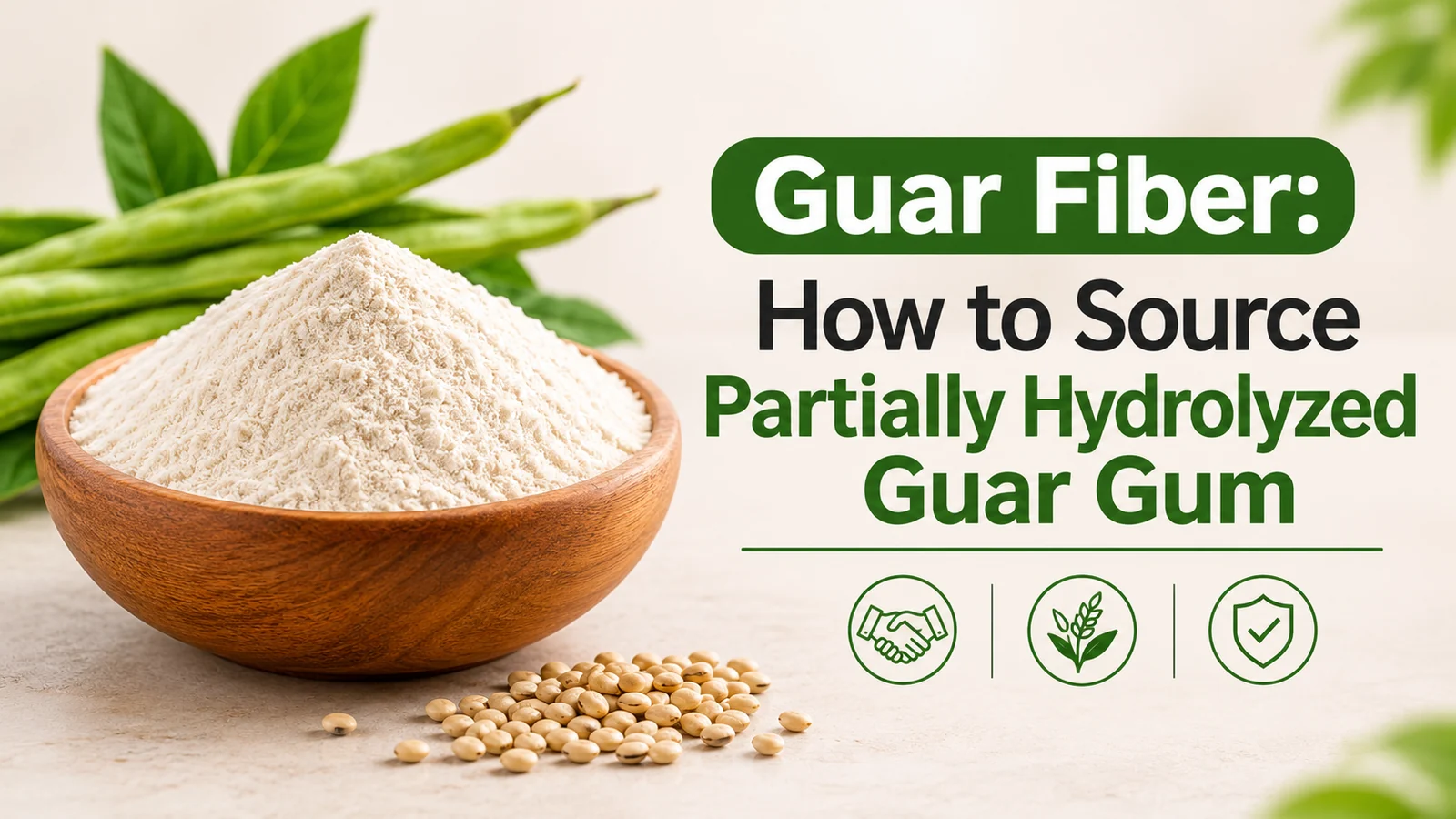
Sourcing guar fiber is harder than it should be, and the reason is simple: the phrase covers two quite different products. Ask ten suppliers for a quote against the same brief and the prices can differ by a factor of three, because some are quoting a thickener and some are quoting a dietary fiber. They are not the same ingredient and they do not do the same job.
This guide covers what to specify, what to check before you commit, and what actually moves the price per kilogram.
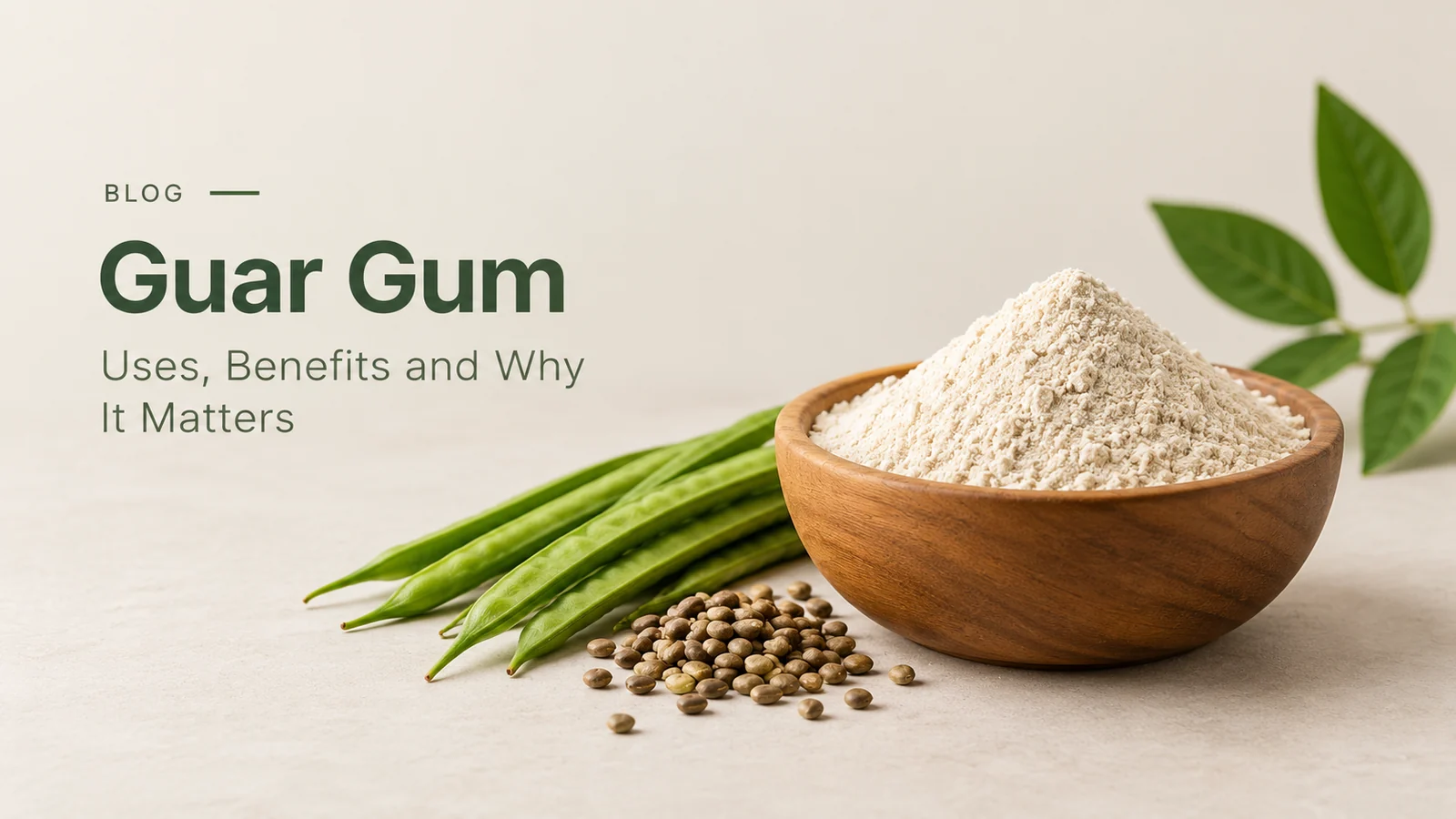
Guar fiber comes from the guar bean, Cyamopsis tetragonoloba, a drought-tolerant legume grown across the semi-arid belt of north-west India. The bean is split, the endosperm separated from hull and germ, and that endosperm is milled into guar gum - a galactomannan made of long, water-grabbing polysaccharide chains.
A note on spelling before we go further, because it affects what you find when you search. American buyers and documentation write guar fiber and partially hydrolyzed guar gum. British, Indian and Australian sources write guar fibre and partially hydrolysed guar gum. Same ingredient, two spellings, and suppliers often index under only one of them.
This is the distinction that causes most sourcing confusion, so it is worth being precise.
Native guar gum is a thickener. Those long chains hydrate fast and build viscosity aggressively, which is exactly what you want in a sauce, an ice cream or a drilling fluid. As a nutritional fiber it is impractical: the dose needed to make a meaningful claim would turn most products into gel.
Partially hydrolyzed guar gum, or PHGG, is what you get when those chains are deliberately cut short by a controlled enzymatic process. The fiber content survives. The viscosity largely does not. The result dissolves clear, carries no taste or odor, and can be added at nutritionally relevant doses without changing how the finished product feels in the mouth.
Commercially, the consequence is straightforward: PHGG costs more per kilogram than native guar gum, because of the enzymatic step and the purification and spray drying that follow. If a PHGG quote comes in close to guar gum pricing, you are probably being quoted guar gum. That single check will save you a wasted trial.
Four things on the sheet tell you most of what you need to know.
Usually specified as a minimum on a dry basis, commonly 75% or higher. Ask which analytical method the figure comes from, because results are not directly comparable across methods. Any serious manufacturer will name it without hesitating.
PHGG should be low, and that is the whole point of the ingredient. What matters more than the number is whether the sheet states the conditions it was measured under - concentration, temperature and instrument. A viscosity figure without its test conditions is not a specification, it is a marketing claim.
This is the control variable behind everything else. Hydrolyze too little and viscosity stays high. Hydrolyze too far and the chains break down past the point where they still count as dietary fiber. Consistent molecular weight from lot to lot is the single best indicator that a manufacturer controls its process rather than hoping for the best.
Moisture, ash, pH, particle size, heavy metals and microbiology. Unglamorous, but these are what hold up a shipment at a port or a customer audit. Ask whether a certificate of analysis ships with every lot or only on request. The answer is revealing.
PHGG is one of the very few ingredients that qualifies as a low FODMAP prebiotic fiber, which is why it appears so consistently in products aimed at people managing IBS. Most of the alternatives - inulin and FOS in particular - are high FODMAP and have to be excluded from those formulations entirely. If you intend to carry that claim on pack, ask your supplier specifically about low FODMAP certification rather than assuming it, and check what evidence sits behind it.
The same applies to Non-GMO, organic, kosher, halal and allergen-free claims. Each has a certificate behind it, each adds cost, and each needs to be in place before your label goes to print - not after.
Buyers often search for a fixed figure. There isn't one, and any site publishing a flat PHGG bulk price per kg is quoting a range that was out of date the week it was written. What you can do is understand the variables, which makes a quote easier to read and to negotiate:
The practical move is to send your specification and your expected annual volume, and ask for a quote against both. A supplier who will not quote without that information is usually being careful rather than evasive.
India grows the large majority of the world's guar, concentrated in Rajasthan and Haryana. That is why most sourcing conversations end up pointing at a PHGG manufacturer India based, whether you buy direct or through a distributor.
The question worth asking is how close your supplier sits to the crop. A manufacturer that processes its own guar controls more of the chain than a trading desk buying splits on the open market, and that shows up in two places you will care about: how stable your pricing is when the guar market moves, and how quickly a technical question gets a real answer.
Chimique Phytokem manufactures PHGG as Fibre 365 at its own plant in Haryana, from guar processed within its own group. If you are evaluating guar fiber for a formulation, our technical team can send the full specification, a sample and a quote against your volume. Get in touch and you will hear back within one working day. If you want the background on the ingredient first, start with what PHGG is and what it does.
PHGG is a 100% soluble fibre that dissolves clear and adds no thickness. Here is what it is, what it does, and how to buy it.
Read More
In the search for healthier diets, soluble dietary fibre plays a role most formulations still miss.
Read More
Locust bean gum is a natural hydrocolloid used widely — modified guar gum can stand in for it.
Read MoreExploring PHGG for your formulation? Connect with our fibre specialists for technical specifications, samples, pricing, and supply details. Get expert support within one working day.