
What is PHGG? Uses, Benefits, and Why It Matters
PHGG is a 100% soluble fibre that dissolves clear and adds no thickness. Here is what it is, what it does, and how to buy it.
Read More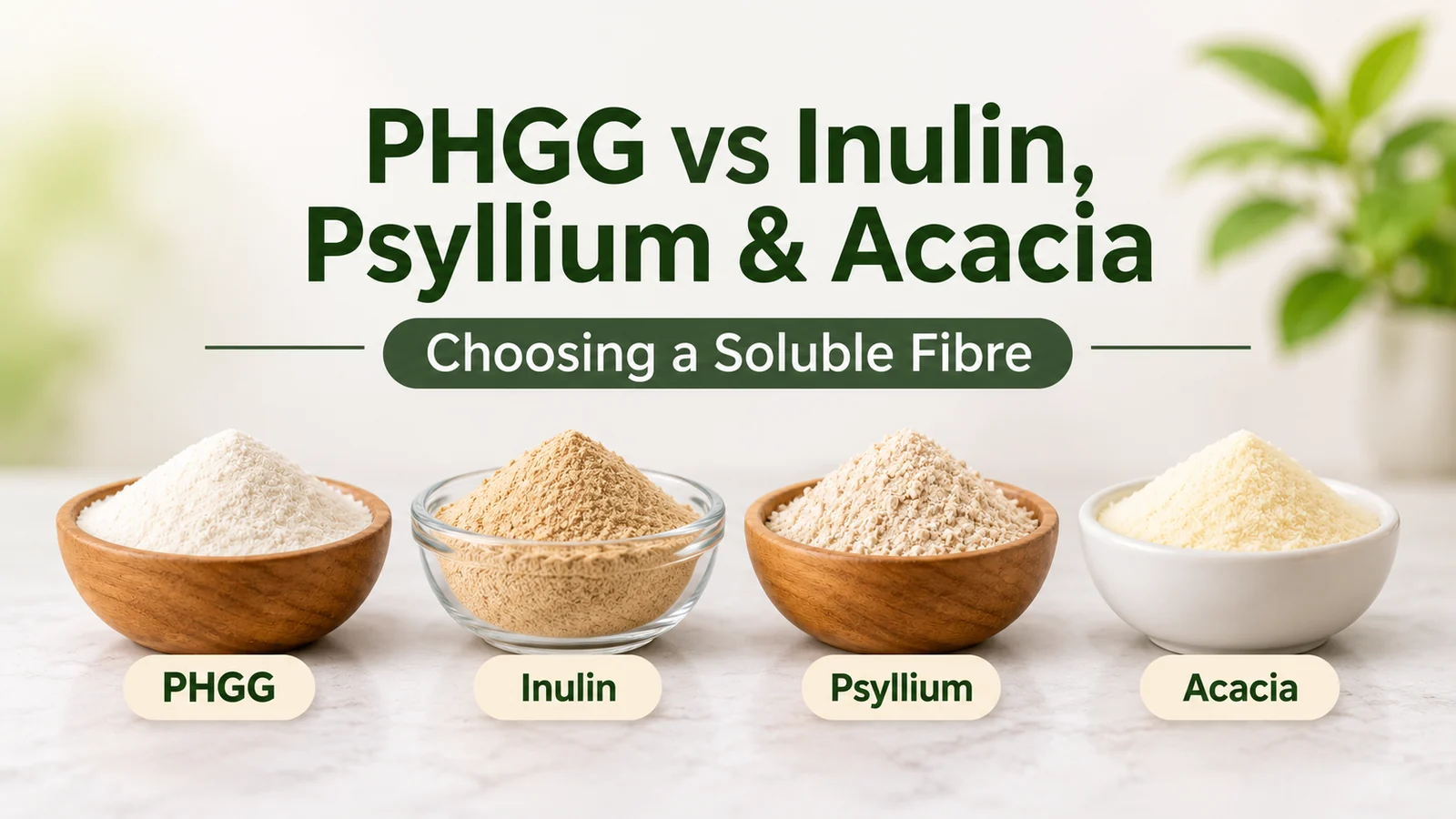
There is no best soluble fibre. There is only the fibre your product can tolerate at the dose your label needs, and the four that come up most often in that conversation are PHGG, inulin, psyllium and acacia.
They behave so differently that comparing them on fibre content alone is close to meaningless. A fibre that is perfect in a capsule can be unusable in a clear beverage. This article compares them on the four properties that actually decide a formulation, and says plainly where each one wins.
One disclosure before we start, because it shapes how much you should trust what follows: we manufacture three of these four. Chimique Phytokem makes PHGG, psyllium fibre and spray dried acacia gum. We do not make inulin. That means we have no reason to talk any of them down, and we would rather you chose the right one than the one we happened to be selling that week.
| Fibre | Source | Viscosity | Clarity | Fermentation | FODMAP |
|---|---|---|---|---|---|
| PHGG | Guar bean | Very low | Clear | Slow, even | Low |
| Inulin | Chicory root | Low to moderate | Can haze | Rapid | High |
| Psyllium | Plantago ovata husk | Very high, gels | Cloudy | Poorly fermented | Low |
| Acacia | Acacia tree gum | Low | Clear | Slow | Low |
PHGG, or partially hydrolysed guar gum, is made by enzymatically shortening the long galactomannan chains in guar gum. The fibre survives, the viscosity does not.
That single property is why it dominates one particular use case: adding meaningful fibre to something that must stay thin and clear. Clear beverages, ready-to-drink teas, flavoured waters, stick packs, and clinical and enteral nutrition where viscosity is a hard limit written into the specification. It also carries no taste, colour or odour, and it survives pasteurisation, baking and freezing.
Where it does not win: if you need the fibre to do structural work - bulking, gelling, holding a dough together - PHGG is the wrong tool. It was specifically engineered not to do that.
Inulin is a fructan extracted from chicory root. It brings something none of the others do: it behaves a little like fat and a little like sugar. That makes it genuinely useful in reduced-fat dairy, in ice cream, and in bars where you want body and a touch of sweetness without the calories.
It also has the deepest body of prebiotic research behind it, which matters if your marketing claim needs citations.
Where it does not win: inulin ferments fast. For a general population that is usually fine; for anyone with a sensitive gut it is the fibre most likely to cause bloating and wind within a couple of hours. It is also high FODMAP, which rules it out of an entire product category - see below.
Psyllium husk is the opposite of PHGG. It absorbs many times its weight in water and forms a gel, and that gel is the point. For laxation, for stool bulking and for the structure it lends to gluten-free baking, nothing else in this list does the job as well.
Where it does not win: anywhere the texture matters. Psyllium thickens aggressively, clouds a solution and is noticeably gritty in a drink. It is also only poorly fermented, so it does comparatively little for the microbiome. If you want a prebiotic effect, this is not the one.
Acacia gum, also sold as gum arabic, is the quiet all-rounder. It dissolves to very high concentrations while staying remarkably low in viscosity, and it is an excellent emulsifier and encapsulating agent. If you are building a beverage emulsion, spray drying a flavour, or need fibre plus emulsification from one ingredient, acacia earns its place.
It is also slowly fermented and low FODMAP, which puts it in similar territory to PHGG for tolerance.
Where it does not win: acacia typically needs a higher inclusion level than PHGG to deliver the same declared fibre, and supply has historically been less predictable, since it is harvested from trees across the Sahel rather than from an annual crop.
This is the single biggest dividing line in the table, and it is often the first thing that narrows the field.
Fructans and galacto-oligosaccharides - which is to say inulin, FOS and GOS - are high FODMAP. For a product aimed at people managing IBS, that is usually disqualifying on its own, however good the prebiotic data is.
PHGG and acacia are both considered low FODMAP while still acting as prebiotics, which is a genuinely unusual combination. A low FODMAP prebiotic fibre is what you need if you want microbiome benefits in a product aimed at sensitive digestion, and the list of candidates is short. Psyllium is low FODMAP too, but as noted it is not really working as a prebiotic.
If you intend to carry a low FODMAP claim on pack, verify certification for the specific grade you are buying rather than relying on the ingredient category. Certification sits with the product, not the ingredient type.
In practice the decision usually falls out of four questions:
And one more worth asking early, because it catches people out late: what dose do you actually need to make the claim you want? A fibre that behaves beautifully at 1g per serving can be unusable at 5g. Always trial at your real inclusion level, not a token one.
If you are weighing these up for a specific formulation, our technical team can send specifications and samples for PHGG, psyllium or acacia and give you a straight answer on which is likely to work - including when the answer is none of ours. Get in touch, or read more on Fibre 365, our PHGG. New to the ingredient? Start with what PHGG is and what it does, or the sourcing guide if you are closer to buying.
PHGG is a 100% soluble fibre that dissolves clear and adds no thickness. Here is what it is, what it does, and how to buy it.
Read More
Two very different products get quoted as guar fiber. Here is how to tell them apart, read a spec sheet, and understand what moves the price.
Read More
In the search for healthier diets, soluble dietary fibre plays a role most formulations still miss.
Read MoreExploring PHGG for your formulation? Connect with our fibre specialists for technical specifications, samples, pricing, and supply details. Get expert support within one working day.