
Guar Fiber: How to Source Partially Hydrolyzed Guar Gum
Two very different products get quoted as guar fiber. Here is how to tell them apart, read a spec sheet, and understand what moves the price.
Read More
Any supplier can send you a good sample. The first lot is almost never the problem.
The problem arrives in year two, when the thirtieth delivery behaves slightly differently from the first, when a customer audit asks for a document nobody can find, or when the guar crop comes in short and your quoted price stops meaning anything. That is where a partially hydrolysed guar gum supplier is actually tested, and it is worth knowing what to look for before you are committed.
Four things separate the dependable from the frustrating.
A single certificate of analysis tells you about one batch. What you need to know is how much the figures move between batches, because that variation is what reaches your production line.
For PHGG the controlling variable is molecular weight. Partial hydrolysis is a balancing act: stop the enzymatic process too early and viscosity stays high; run it too long and the chains break down past the point where they still count as dietary fibre. A supplier that holds molecular weight inside a narrow band batch after batch is one that genuinely controls its process. One that cannot is hoping, and you will find out eventually.
Ask for certificates from several recent, non-consecutive lots rather than a single sample. Compare soluble fibre content, viscosity and particle size across them. The spread tells you more than any single sheet, and a supplier confident in its process will hand them over without hesitating.
Guar is a monsoon-dependent crop grown largely in Rajasthan and Haryana, and it has a history of volatility. Anyone who was buying hydrocolloids in 2012 remembers what a speculative run on guar does to pricing and availability.
This is where the structure of your supplier matters more than their sales pitch. A trading desk buying splits on the open market passes every swing straight through to you, because it has nothing else to absorb it. A manufacturer that processes its own guar has a buffer, and more importantly it has visibility - it knows what is coming before the market does.
The question to ask is blunt and revealing: do you process your own guar, or do you buy it? Everything about your pricing stability and lead times over a multi-year relationship follows from that answer.
Most sourcing conversations treat documentation as an afterthought. It is the thing most likely to cost you money.
A shipment held at a port because a declaration was missing costs demurrage, delays a launch and makes your procurement team look careless to people who do not care whose fault it was. The paperwork is not administrative overhead; it is part of the product.
What to confirm before you commit:
That last point catches people out. A viscosity figure quoted without the concentration and temperature it was measured at is marketing, not specification, and it cannot be compared against another supplier's number.
At some point your formulation team will have a question that the data sheet does not answer. Dosing after pasteurisation. Behaviour at low pH. Whether the material will survive a particular drying step.
The difference between a supplier who answers that in a few hours and one who takes three weeks to come back via a distributor is, in practice, the difference between a development cycle that finishes and one that stalls. When you are evaluating a PHGG supplier, send a real technical question early and see what comes back. The quality and speed of that answer is a better predictor of the relationship than anything in the brochure.
We manufacture PHGG as Fibre 365 at our own plant in Bhiwani district, Haryana, from guar processed within our own group. Our parent company, Chimique India Ltd, has been manufacturing guar gum powder since 1981 and runs distribution centres in the USA, Germany and Canada.
In practice that means the four points above are structural rather than promises. We hold sixteen certifications and accreditations covering food safety, quality management, environment and occupational health. A certificate of analysis ships with every lot. We currently supply customers in more than twelve countries, and our technical team replies within one working day.
As a PHGG manufacturer India based and backward-integrated into guar, we are closer to the crop than most of the market - which is what lets us hold a price and a lead time when the season turns.
No. Guar gum is a thickener built on long galactomannan chains. PHGG, sometimes written hydrolysed guar or sold as guar fiber, is what you get when those chains are enzymatically shortened. It keeps the dietary fibre and loses almost all the viscosity, which is why it can be added to a clear drink without changing it.
There is no fixed figure, and any published one is out of date. Price moves with the guar crop, the grade and guaranteed fibre content, order volume, packaging format, certifications and the Incoterms you buy on. Send your specification and expected annual volume and ask for a quote against both - an ex-works number and a delivered number are not comparable.
Yes. PHGG is one of the few ingredients that works as a low FODMAP prebiotic fibre, which is why it appears so often in products aimed at people managing IBS. Inulin and FOS, the usual prebiotic alternatives, are high FODMAP. If you intend to carry the claim on pack, verify certification for the specific grade you are buying.
Yes. Samples, the full specification and current certifications are available on request, and we would rather you trialled the material at your real inclusion level than a token one.
If you are evaluating a partially hydrolysed guar gum supplier for a formulation, get in touch and you will hear back within one working day. You can also read more about Fibre 365, our PHGG, or start with what PHGG is and what it does. If you are comparing it against other soluble fibres, our comparison with inulin, psyllium and acacia covers that, and the sourcing guide goes deeper on reading a specification sheet.
Two very different products get quoted as guar fiber. Here is how to tell them apart, read a spec sheet, and understand what moves the price.
Read More
PHGG is a 100% soluble fibre that dissolves clear and adds no thickness. Here is what it is, what it does, and how to buy it.
Read More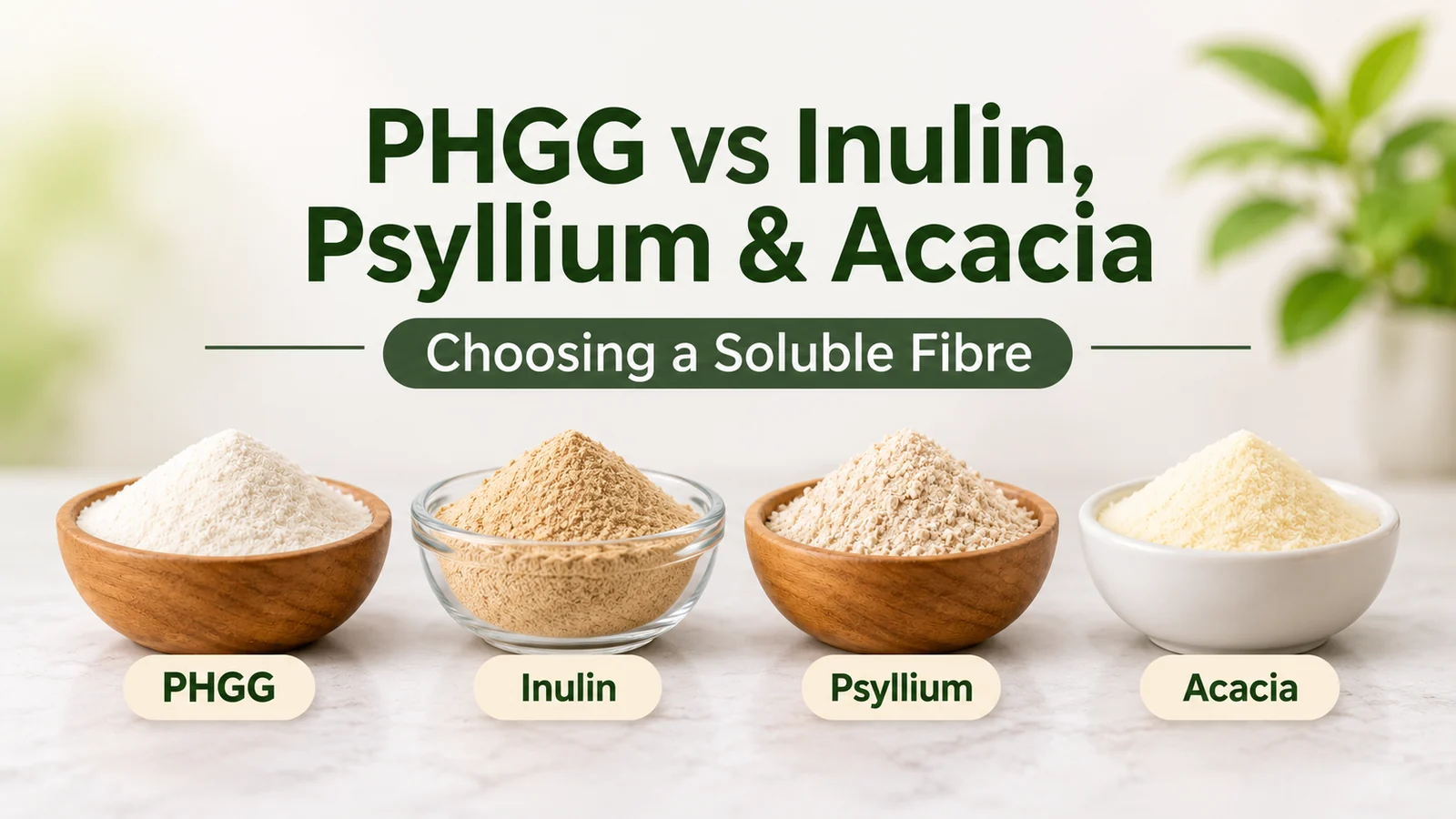
Four soluble fibres, four very different jobs. A straight comparison on viscosity, clarity, fermentation and FODMAP status.
Read MoreExploring PHGG for your formulation? Connect with our fibre specialists for technical specifications, samples, pricing, and supply details. Get expert support within one working day.